
 Learning from Mom: Asmara’s Orangutan Parenting Lessons
Parenting classes are in session for Asmara, the 11 year-old-orangutan, led by a team of devoted teachers ready to help her learn.
“Maternal training with Asmara was an ongoing practice for quite some time.” Says Angie Selzer, Senior Animal Care Specialist and the Association of Zoos and Aquariums Orangutan Species Survival Plan Coordinator. “When we discovered Tara, Asmara’s mother, was pregnant, we trained heavily with both orangutans: We worked with Tara to reinforce maternal behaviors and with Asmara in the hope that she will be ready when it comes time to start her own family.”
The team aimed to have two behaviors mastered before the new baby’s arrival: presenting behavior, and a bottle feed behavior.
Presenting behavior would be critical, in which the orangutans would safely present the baby to the Animal Care Team for closer examination. Once the mother-daughter duo showed continued success in presenting, they moved on to bottle feeding. This behavior focuses on the orangutan safely presenting the baby to the Animal Care Team and hold while the team member bottle fed if nursing wasn’t an option.
Since Asmara’s infancy, she has witnessed Tara voluntarily participating in her training and the trusting relationship between her mother and their care team. Now more than ever, it would be important for that trust to be translated and passed down to the next generation.
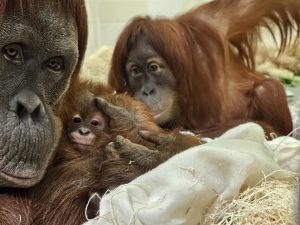
On January 11, 2026, Tara gave birth to a healthy baby girl named Raya and the Animal Care Team were pleased to see Tara immediately begin nursing and acting as an attentive mother, all under the curious and watchful eyes of big sister, Asmara.
“In the wild, orangutan babies stay with their mother for about eleven years,” says Emily Fryda, Animal Care Specialist. “During that time, daughters learn by watching. Now, Tara is showing her the ropes of what maternal behavior looks like. This experience will help Asmara mature and prepare her for motherhood one day.”
Like any good classroom, the teacher sets the pace. Tara guides the interactions, setting boundaries when Asmara gets a little too enthusiastic and inviting her in when appropriate. One of the more heart-warming signs of progress: Tara and Asmara gently grooming Raya together.
“We continuously monitor Tara and let her lead,” Selzer adds, “Mom is in charge and we trust her to show us how we can support her, Asmara, and now Raya.”
As Asmara grows in confidence and skill, the team is also looking ahead to her role in the Association of Zoos and Aquariums Orangutan Species Survival Plan (SSP), a conservation initiative designed to sustainably maintain healthy, genetically diverse populations to ensure the survival of the species.
“As the SSP Program Coordinator, I manage both Bornean and Sumatran orangutan populations in North America,” Selzer explains. “Because Sumatran orangutans are critically endangered, Asmara’s genetics are incredibly valuable to her species’ survival. The work being done now is giving her the confidence to one day leave Tara – just as orangutans do in the wild – and raise her own little one.”
We’ll continue sharing updates on Asmara’s learning journey on our website and social media. Stay tuned as this remarkable orangutan family writes its next chapter.
Written by Lauren Mills, Communications Manager